Search our Physician Database to find the one that is right for you.

Search our Physician Database to find the one that is right for you.
What is Fluoroscopy?
Fluoroscopy images are created by passing small, highly controlled amounts of radiation through the body and capturing the resulting shadows and reflections on film. Most people are familiar with x-ray images, which produce a still picture of the body’s internal organs. A similar imaging method, fluoroscopy, uses x-rays to capture a moving image of an organ while it is functioning. Though still x-ray can be useful in examining the body, fluoroscopy is often the most effective way to view the esophagus, stomach, small bowel, colon, and rectum. Fluoroscopy may be an alternative method for evaluation of the spinal cord or bony joints for patients that are not MRI compatible. It can also be used the view the bladder and urinary tact.
What are the Preps for Fluoroscopy Procedures?
Patients should tell their doctor about any recent illnesses or other medical conditions, as well as any allergies they might have to medications. Patients must bring a list of all medications. Women should always inform their doctor or X-ray technologist if there is any possibility of pregnancy.
The referring doctor will give instructions on how to prepare for procedures. Patients will be asked to change into a hospital gown and remove jewelry, eyeglasses, or any metal objects that could cause artifacts on the images.
NOTE: See Avandamet, Glucophage, Glucophage XR, Glucovance Metformin, Metaglip, Fortamet, Actoplus Met, Glumetza, Janumet, Prandimet, Riomet and Kombiglyze XR Policy
Radiology Procedure Guide - Fluoroscopy Procedures
| Procedure | Prep | Estimated Time of Study |
|---|---|---|
| Barium Swallow UGI Small Bowel Series |
AM Procedure Prep: NPO after midnight Diabetic patients should take insulin or oral medications and follow with clear liquid breakfast |
30 minutes to 1 hour Small Bowel Series will take 1 to 2 hours |
| Barium Enema (BE) | AM Procedure Prep: Diabetic patients should not take insulin or oral medication for AM appointments. PM Procedure: Diabetic patients should take insulin or oral medication with liquid breakfast **MAG Citrate can be purchased at any drugstore |
15 to 30 minutes |
| IVP | AM Procedure Prep: **Diabetic patients should not take insulin or oral medication prior to AM appointments * see: Avandamet, Glucophage, Glucophage XR, Glucovance, Metformin, Metaglip, Fortamet, Actoplus Met, Glumetza, Janumet, Prandimet, Riomet and Kombiglyze XR Policy Age 50/above must have I-Stat Creatinine level if diabetic or hypertensive. All patients age 70/above must have recent (30 days) Creatinine level for IV contrast **MAG Citrate can be purchased at any drugstore 1 hour |
1 hour |
| VCU Cystogram | May continue with meals and medication VCU will require catheter placed in the bladder Routinely scheduled at 10 a.m. or 2 p.m. |
30 to 60 minutes |
| Myelogram Arthrogram Fistula Study | NPO 2 hours prior to appointment May continue medication CT imaging may be requested post Myelogram MRI imaging may be requested post Arthrogram |
45 minutes to 1 hour Patients may be held 30 to 45 minutes for observation post procedure |
| Enterocolysis | Take 4 Dulcolax laxative tablets 6 p.m. day prior to exam. NPO after midnight Schedule at 9 a.m. or 10 a.m. |
45 minutes to 1 hour |
| Defecography | May continue with meals and medication Schedule at 9 a.m. or 10 a.m. |
30 to 45 minutes |
| Swallow Evaluation with Speech Therapy | May continue with medication and physician orders for meals. | 20 to 30 minutes |
NPO—Nothing to eat or drink
Clear Liquids—Water, clear broth or bouillon, coffee or tea with sugar and all the following that are not colored red Gatorade, soft drinks, Kool-Aid, Jello, or ice popsicles
How is a Fluoroscopy Procedure performed?
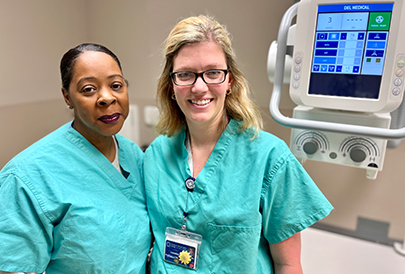
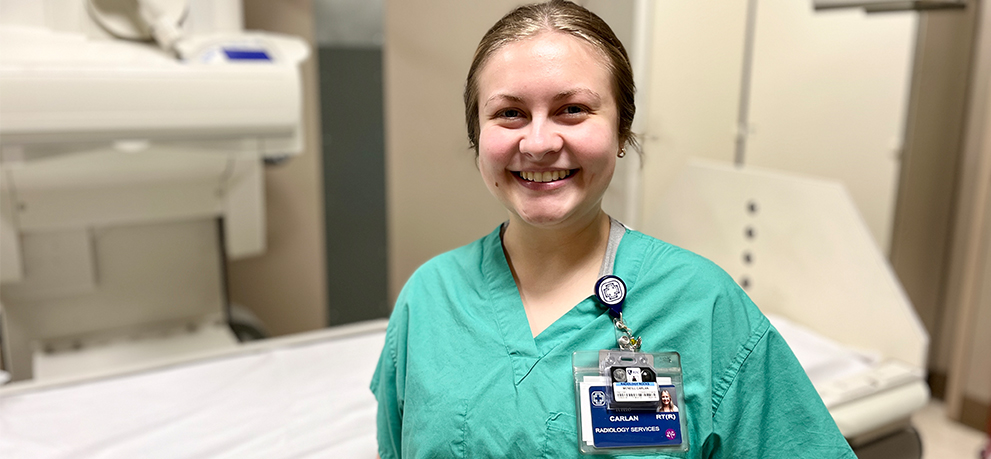
A technologist will complete a medical history form and answer any questions the patient may have. The equipment used for fluoroscopic procedures consists of a large, flat table and a moveable apparatus that extends over the table. This apparatus sends real-time images to a television monitor. The patient will be placed on the table usually on their back or side. The table can move or tilt to the best location for imaging specific body organs.
Common uses for Fluoroscopy Imaging
Radiology Report Turnaround process
A radiologist, who is a physician experienced in Fluoroscopy and other radiology procedures, will analyze the images and send a report to the patient’s referring
physician. The referring physician will inform the patient of the procedure findings.
We have a departmental goal of 6 hours for Radiology Report Turnaround time. We measure the time from radiology request entry to the time the transcriptionist types the final report. The radiology report is also available via our Digital Dictation System, immediately after Radiologist completes dictation. The DVI system phone number is 377-3745. You must first enter your six (6) digit PIN number, your department number, and the patient’s medical record number to access the report.
What are the Benefits VS Risks?
Benefits-
Risks-
New Procedures
We currently have a Siemens digital fluoroscopy machine and a Fuji Computed Radiology (CR), which allows for better management of fluoroscopic images, in the Main Radiology Department and Digestive Health Center.
Pediatric Preps for Fluoroscopy
It is desirable that small children not be kept NPO, but receive clear liquids particularly in the case of IVP’s and barium enemas so that the child does not become dehydrated. It is desirable that the child be kept NPO for a short period of time prior to an UGI series so that no fluid remains in the stomach. When questions arise as to preps, the patient’s attending physician and/or radiologist should be consulted concerning the specific patient and problem. Patients must bring a list of all medications.
Clear Liquids: Water, clear broth or bouillon, tea with sugar, all of the following that are not colored red: Gatorade, soft drinks, Kool-Aid, jello, or ice popsicles.
Radiology Pediatric Prep Guide
| Procedure | Prep | Estimated Time of Study |
|---|---|---|
| IVP/ VCU | Clear liquids after evening meal day prior to exam
May continue medication |
1 hour 2 hours if ordered with Renal Ultrasound |
| VCU only | May continue meals and medication | 45 minutes 1½ hours if ordered with Renal Ultrasound |
UGI Small Bowel Series |
Clear Liquids after midnight until 6 a.m. INFANTS MAY CONTINUE WITH REGULAR FEEDING UNTIL 6 A.M. |
30 minutes to 1 hour |
| Barium Enema | Follow referring Physician orders or clear liquids 12 hours prior to exam Fleets enema 8 p.m. evening prior to exam. Saline enema 6:30 a.m. morning of exam * Fleets and saline enema can be purchased at local drugstore |
30 minutes |