Search our Physician Database to find the one that is right for you.

Search our Physician Database to find the one that is right for you.
What is MRI Imaging?
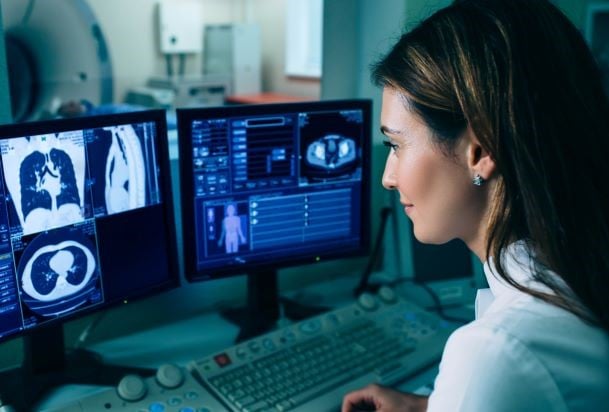
MRI (magnetic resonance imaging) is a diagnostic tool that examines tissue water and fat. Unlike x-ray based techniques, MRI uses a magnet and radio waves to produce images of normal and pathologic tissues. The technique has proven very valuable for the diagnosis of a broad range of conditions in all parts of the body. MRI is being used to evaluate cancer, heart and vascular disease, stroke, joint, and musculoskeletal disorders. MRI requires specialized equipment and expertise and allows evaluation of some body parts that may not be as visible with other radiology procedures.
What are the preps for MRI Imaging?
MRI is a relatively safe imaging technique; however, it is not for all patients. The MRI staff carefully screens all patients prior to entry inside the MRI work area. Patients with a Heart Pacemaker can not be scheduled for a MRI study. Other contraindications are: Heart Pacing Wires, Implanted Defibrillators, Aneurysm Surgical Clips, Cochlear Implants, Implanted Tents Units, Implanted Metal Plates, Bullets/Shrapnel, and obesity (over 300 pounds-most will fit depending on the type of exam). Some tattoos and permanent eyeliner may cause discomfort. Most other surgical pins, screws, rods, artificial heart valves and vascular stents that have been in place 6 to 8 weeks are okay. Dental work, braces, or other metal close to the area of interest will cause image artifacts. Please inform patients that anything that might degrade the MRI images will have to be removed (such as hairpins, jewelry, medication patches, eyeglasses, hearing aids, and any removable dental work).
The MRI staff will ask about drug allergies and document a medical/surgical history. If there is a chance of pregnancy, the MRI technologist should be informed. Some patients may require a mild sedative to overcome claustrophobic feeling. This should be obtained from the referring physician prior to arrival. If sedatives are used, patient will need someone to drive them home.
Radiology Procedure Guide MRI:
| Procedure | Prep | Estimated Time of Study |
|---|---|---|
| MRI: Brain, IAC, Orbits, Neck | May continue meals and medications Must be able to lie supine 30 minutes
All stents must be in place 8 weeks Tooth fillings, permanent dental work or braces may cause image artifacts No bullets or shrapnel Any implanted metal in the region of interest will cause artifacts If indicated IV contrast is injected via small needle in hand or lower arm. See policy below. |
30 minutes |
MRA Cerebral Carotid Renal Aorta Extremity |
May continue meals and medications Must be able to lie supine 30 to 45 minutes No pacemaker All stents must be in place 8 weeks Tooth fillings, permanent dental work, or braces may cause image artifacts No bullets or shrapnel Any implanted metal in the region of interest will cause artifacts If indicated IV contrast is injected via small needle in hand or lower arm. See policy below. |
30 to 45 minutes |
| MRI C-Spine,T-Spine, L- Spine Pelvis, Hip, Extremity |
May continue meals and medications Must be able to lie supine 30 to 45 minutes No Pacemaker No removable dental work for a C-Spine All stents must be in place 6 to 8 weeks No bullets or shrapnel Any implanted metal in the region of interest will cause artifacts If indicated IV contrast is injected via small needle in hand or lower arm. See policy below. |
C-Spine, T-Spine & L-Spine (20-30 minutes) Pelvis, Hip & Extremity (60 minutes) |
MRI Cord Compression, Breast, Liver, Pancreas, Heart |
May continue meal and medications Must be able to lie supine 90 minutes No Pacemaker All stents must be in place 8 weeks No bullets or shrapnel Any implanted metal in the region of interest will cause artifacts If indicated IV contrast is injected via small needle in hand or lower arm. See policy below. |
45 to 90 minutes Cord Compression, Breast, Liver & Pancreas (60 minutes) Heart (90 minutes) |
| MRCP (Magnetic Resonance Cholangiopancreatography) |
NPO 4 hours prior to appointment May continue medication Must be able to lie supine for 1 hour No Pacemaker All stents must be in place for 8 weeks No bullets or shrapnel Any implanted metal in the region of interest will cause artifacts If indicated IV contrast is injected via small needle in hand or lower arm. See policy below. NPO—Nothing to eat or drink |
30 Minutes |
***MR IV Contrast Media Policy***
Purpose:
The purpose of this policy is to ensure that the renal function on patients that receive MR IV Contrast Media during Radiology procedures is not diminished as a result of receiving the contrast media.
All outpatients that are age seventy (70) or on any patient with Renal Vascular Disease, and patients that are fifty (50) years old with clinical history of Diabetes or Hypertension Disease shall routinely have creatinine/GFR laboratory test and results on the chart prior to administration of IV contrast media for Radiology procedures. The creatinine/GFR test can be performed in conjunction with chemistry profiles. Copies of the results should be faxed to Outpatient Scheduling (662-377-4722) along with orders for procedures or can be sent with the orders and the patient. Also creatinine/GFR test results that have been preformed within thirty (30) days are adequate unless the patient is transitional and fragile which may result in changing values for these lab tests.
How does MRI work?
MRI is a unique imaging method because, unlike the usual X-Ray, Nuclear Medicine, and even CT scanning, it does not rely on ionizing radiation. Instead radio waves are directed at protons, the nuclei of hydrogen atoms, in a strong magnetic field. The protons are first excited and then relaxed emitting radio signals, which can be computer processed to form an image. In the body, protons are most abundant in the hydrogen atoms of water — the "H" of H 2 O -- so that an MRI image shows the differences in the water content in body organs or tissues (even different types of tissue within the same organ). For example the gray and white matter of the brain can easily be distinguished with MRI. Each MRI procedure has its own protocol which demonstrates contrast differences and shows a cross-section image of the body part.
How is the MRI exam performed?
Technologist will complete a medical history form and answer any questions.
The patient will lie on a sliding table and be positioned comfortably usually on their back. Patients are offered earplugs to reduce the loud tapping or knocking noise during the imaging phases. If indicated IV contrast is injected via small needle in a vein in the hand or lower arm. MRI equipment (coil) is place near the body part or region of interest. The MRI table will slide into the bore or opening in the magnet. The patient will be able to communicate with the technologist by intercom. It is important that the patient follow any instructions and lie still during the imaging phase. Typically, most procedures last 30 to 45 minutes depending on the number of images needed. Patient must bring a list of all medications.
The most common uses of MRI Imaging:
Radiology Report Turnaround process
A radiologist, who is a physician experienced in MRI and other radiology procedures, will analyze the images and send a report to the patient’s referring
physician. The referring physician will inform the patient of the procedure findings.
We have a departmental goal of 6 hours for Radiology Report Turnaround time. We measure the time from radiology request entry to the time the transcriptionist types the final report. The radiology report is also available via our Digital Dictation System, immediately after Radiologist completes dictation. The DVI system phone number is 377-3745. You must first enter your six (6) digit PIN number, your department number, and the patient’s medical record number to access the report.
What are the Benefits VS Risks?
Benefits-
Risks-
New Procedures
We currently have 4 General Electric MRI units (1 unit is a 3 Tesla). The technology in the MRI areas allows faster imaging times for noninvasive and cost effective diagnostic evaluations.
The MRI technology we have today enables a noninvasive evaluation of the heart and circulation within minutes.