
Summary
Breast imaging specialist Dr. Joanna Sadowska explains BI-RADS scores, breast density categories and the reasons for callbacks for additional mammography images.
Annual screening mammograms are our best opportunity to find breast cancer early.
The American College of Radiology recommends breast cancer screening with mammography starting at age 40 for women at average risk.
Understanding BI-RADS Scores
The American College of Radiology developed the Breast Imaging Report and Data System (BI-RADS) so radiologists can communicate clearly and consistently about what your mammogram shows.
- Category 0: Incomplete. The doctor needs more pictures or older scans to compare
- Category 1: Negative. Normal mammogram.
- Category 2: Benign. Mammogram may note harmless things like cysts or old scars.
- Category 3: Probably Benign. The finding has less than 2% chance of cancer but needs follow up in six to 12 months.
- Category 4: Suspicious. Findings in question need biopsy/tissue sample for diagnosis.
- Category 5: Highly Suggestive of Malignancy. Findings with high chance (95% or more) of being cancer. Biopsy is strongly urged.
- Category 6: Known Cancer.
Breast Density Levels
Your mammogram report also includes information on breast density. Breast tissue consists of two types: fatty and fibroglandular. If more than 50% of your breast is made of fibroglandular tissue, then your breasts are classified as dense.
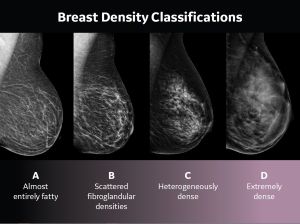
Breast density isn’t abnormal, but it does make it harder to read your mammogram. On an X-ray mammogram, fatty breast tissue appears gray, while both dense breast tissue and cancers show up as white. That means a cancer can easily hide in a background of dense breast tissue.
Additionally, women with dense breast tissue have a higher risk of developing breast cancer than women with less fibroglandular tissue in their breasts.
Mammography is the only way to determine breast density. On the report, radiologists score density in four different categories:
- A (Fatty): Mostly fatty tissue
- B (Scattered Fibroglandular): Some scattered dense areas
- C (Heterogeneously Dense): Many dense areas; harder to spot small issues
- D (Extremely Dense): Very dense tissue; hardest to read
For women with dense breast tissue (categories C and D), supplemental screening with automated breast ultrasound (ABUS) is recommended in alongside your annual mammogram.
Callbacks
Being called back after a mammogram usually means the doctor needs a clearer or focused picture of a specific area. About one in 10 patients needs a callback, with vast majority turning out to be free of abnormal findings.
Common reasons for a callback after a screening mammogram include:
- Overlapping or dense tissue
- First (Baseline) mammogram
- Asymmetry: One side looks different from the other or from the surrounding tissue
- Calcifications: Tiny calcium spots within breast tissue
- Mass or lump
- Blurry or unclear pictures
Breast cancer symptoms
In addition to following the breast cancer screening guidelines, women need to know what is normal for their bodies. Breast cancers can develop in women who haven’t reached the age for routine screening or between screening mammograms.
The most common symptom of breast cancer is a new lump. A painless, hard, fixed mass that has irregular edges is more likely to be cancer, but breast cancer can also be soft, round, tender or painful.
If you have these symptoms or other changes in your breasts or nearby lymph nodes, you should talk to your gynecologist or primary care provider about having them evaluated promptly.

Joanna Sadowska, DO
Dr. Joanna Sadowska is a board-certified radiologist and breast imaging specialist with Premier Radiology.

MyChart (also known as myConnection)
Schedule your next appointment, start an E-visit, communicate with your doctor, request prescription refills and access your test results — just a click away.
Related Links
Topics
- Managing Your Health
Share
Schedule a mammogram online or call Centralized Scheduling at (662) 377-6655 or 1-866-912-1486.


Subscribe to Our Newsletter
Like this content and want to get more? Sign up for True North, the health and wellness newsletter from North Mississippi Health Services!
Subscribe to Our Newsletter
Like this content and want to get more? Sign up for True North, the health and wellness newsletter from North Mississippi Health Services!

Nurse Link®
Not sure if you need Urgent Care or the ER? Call 1-800-882-6274 anytime to speak directly to a registered nurse and get immediate answers. Using computerized medical protocols, nurses direct callers to the most appropriate treatment. Our nurses are available 24 hours per day, seven days per week.